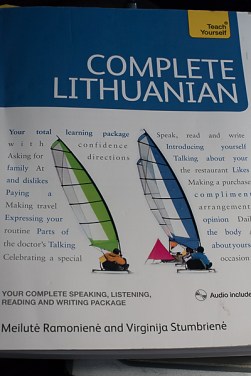
One of my language guides. Ačiu, Meilutė ir Virginija!
So I’ve been firing up the old Language 101 skills on Lithuanian. Boy, it’s trickier than most. It has more grammar than German (which I thought had plenty), and I’m told it has structures in common with Ancient Greek and Sanskrit. Joy. There are a few cognates to other modern languages, but not all that many to hang your hat on.
Rosetta Stone doesn’t cover Lithuanian. Only 3 million native speakers do not a market make, I suppose. Thank goodness we now have the Internet to help with obscure things.
This gal has very helpful videos on her YouTube channel to learn some basic vocabulary and pronunciation. Clear, methodical — a good teacher. She’s cute, too. Thanks to Kristina I know a few numbers: vienas, du, trys, keturiasdešimt penki. A few family relations: vyras, žmona, dukra, sūnus, tėvas, motina, senelis, močiutė, brolis, sesuo. I also know a few drinks: vanduo, kava, arbata, sultys, vynas, alus, degtinė, tekila.
Speaking of drinks, thanks to the Pimsleur Lithuanian 1 course (link), I also have a pick-up line. Ar jūs norėtumėte ką nors gerti pas mane? (Would you like something to drink back at my place?) We’ll see if I get to use it. So funny that they wrote their course in a flirty way.
Some other fun observations so far:
 Lithuanians trill all their Rs, which is fun to do. It gets you purring like a kitten. Either that, or we’re entering Mordor.
 - The vowels are trickier than the consonants. Both sound and duration can vary with different accent marks. And my pronunciation of the diphthongs got closer when I realized I wasn’t trying to hit one compound vowel sound but rather hit the two vowels in sequence. The sequence itself has a pacing and melody. Kind of fun to try and get right.
- The number of word inflections / declensions is insane. Apparently, only Finnish is more insane. The same root words get multiple different endings depending on where in a sentence they’re being used. And the root words themselves are pretty heterogeneous (there are 4 masculine endings and 2 feminine endings, with plurals for each, all of which shift differently into 7+ grammar cases). So I guess you have do matrix multiplication to compose a Lithuanian sentence. Good thing I studied math.
- For example,
- Vilnius, the capital city, is a masculine noun and takes (-us) in the nominative case, as in “Vilnius is the capital city.”
- If you want to go “to Vilnius”, that’s accusative case and you’re going į Vilnių.
- If are “near Vilnius”, then that preposition takes genetive case and you’re prie Vilniaus.
- And if you happen “to live in Vilnius”, then there’s no preposition but instead the locative case ending to indicate location and you gyventi Vilniuje.
- For masculine nouns with other endings (-as, -is, ys) and for feminine nouns, such as Lithuania (Lietuva), each of these endings shifts differently (Lietuvą, Lietuvos, and Lietuvoje, respectively).
- For reasons that mystify me, according to Complete Lithuanian, some verbs take accusative case for the direct object when stated positively, but take the genetive case when stated in the negative. Aš turiu brolį (I have a brother) vs. Jis neturi brolio (he doesn’t have a brother).
- I haven’t even learned dative case endings yet. And there’s also Vocative case, which is when you’re addressing someone explicitly.
- No wonder my Lithuanian friend Rasa tells me that even native speakers get their endings wrong a lot. And one western dialect tends to just drop them. Good call.
- Like many languages, Lithuanian has diminutive endings that make words “cute”. Spanish has -ito. German has -lein and -chen. But of course, Luthianian has four! of them (-uk, -ut, -yt, -el) and you insert them before the gender and singular/plural endings, but you drop those other endings if you’re speaking to that person. Riiight. I’m learning that Lithuanians like to make up a bunch of nicknames for people, which must be a cultural trait because my mother always had a rotating roster of 10 pet names for me, my dad, each pet, etc. I just answered to whatever she said in my direction. Recently, that has included “asshole”, which I’m sure she means affectionately.
- Bottom line — pay attention to the root word. Don’t ignore the ending exactly, because it can convey meaning and nuance, but don’t sweat it, either.
- Curse words. Of course with any language, it’s fun to learn the curse words straight away. I think I know more curse words in Spanish than I do other words. The very worst Lithuanian swear, apparently, is to call someone a “toad” (rupūžė). Click here to watch The Most Interesting Lithuanian Ladies in the World explain that one. My mom tells me she remembers her dad saying “rupūžė” when he was mad.
Mom spoke Lithuanian at home as a young child in Queens, New York, but lost it later. Today, when we were talking about food words, she recalled aš nenoriu (I don’t want it), which is exactly what 5-year-olds say at dinner in every language. I’m very curious what other bits of language are deep in that 76-year-old brain of hers that will rise to the surface on this trip.


 Exploring our Lithuanian Roots