
Birutė Zubrienė and Vytautas Zubrus show us the site where the Mardosa family house was located.
So I’m way behind on blogging this trip. Between doing stuff, meeting people, taking pictures, photo editing, and writing, there’s barely time for eating and sleeping.
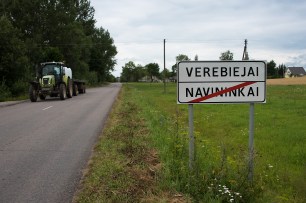
Verebiejai, Lithuania. Doesn’t look much different from Manor, Texas, actually. The slash shows the town you’re leaving.
On Saturday, mom and I took the stinky Astra with the gorked clutch out to the country, to a little village called Verebiejai (ver-bee-yay), which my great grandfather Antanas Mardosa listed as home on his naturalization papers. Turns out we definitely found the right people! We were made so welcome by mom’s 2nd cousin Birutė Zubrienė and her son Vytautas Zubrus (pictured above), who provided excellent translation.
Here’s how we know we definitely found the right people: in a drawer somewhere, Birutė had a picture of my mom when she was two (shown being held by Anthony and Mary Mardosa in New York). I guess the proud grandparents sent the snap to show the folks back home. It’s the same picture I saw for the first time just a few days earlier in Texas (featured on a previous post). Imagine my surprise to see it again across the world!
Of that generation, Anthony and two sisters, Cecilia and Mary (below), ventured to the United States around 1906-1909, landing in Brooklyn, NY. Here’s more pictures we didn’t have before.


Three other siblings stayed in Lithuania, apparently. Konstancija (pictured with the outside group, seated) had a large family and is Birutė’s grandmother.
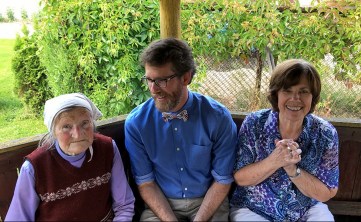
Visiting in the gazebo with 91-year-old Isabele (mom’s 1st cousin once removed)
I don’t believe we have pictures for the other sister Morta and brother Juozas, but we did meet Juozas’ 91-year-old daughter Isabele, who is a neighbor of Birutė’s. Pictured is us chatting with her in her little gazebo outside the house (most of the houses there have one to sit and visit outside in the summer). I suppose that makes her my mother’s 1st cousin once removed, and the closest possible relation we could find. She was super sweet and still getting around the house (in Crocs, no less!) at 91 despite a tough life and the loss of her children and husband.
It was such a treat to visit with these cousins. Birutė — who is cousin Eglė’s grandmother and our chief informant on all things Mardosa family — outdid herself and made us a wonderful meal of cold beat soup (šaltibarščai), a bacon and potato dish called kugelis, vegetables from her garden, and many other wonderful dishes. She sent us home with most of a poppy seed pastry roll from the store that was scrumptious and quite similar to the Czech version Dan likes so much.
How we connected is kind of amazing. Credit the power of the Internet coupled with the small-town grapevine. About a month and a half ago, I emailed the administrator of a local history website about Verebiejai, having found some descriptions of the Mardosa family that I was able to read with the help of Google Translate. I listed all the relatives I knew about and fired off the email as a shot in the dark. Well, that email apparently got passed around the staff of the regional history museum in Alytus, which sponsored the website, and a neighbor of Birutė’s, who works there, came by to chat about it. Birutė realized that yes, indeed, those were her peeps I was talking about, and she put her English-speaking granddaughter Eglė on the case.
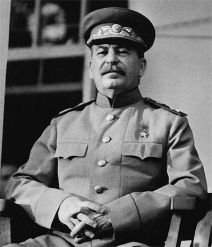
You bastard!
The Verebiejai history website takes several oral accounts from old codgers in town, and talks a bit about the rough 20th century history that the town (and really, all of Lithuania) had to endure. German soldiers apparently took up positions at the Mardosa farm during WWII, which brought the fighting with the Russians right to their doorstep. That must have been scary as hell. Then later, when Stalin took over, many people who owned land, or were otherwise in the way of the glorious new Communist order, got unceremoniously shipped to Siberia, most never to be seen again. This is a story we heard over and over again: “sent to Siberia.” I’m told you got a knock on your door at night and one hour to pack a bag, and that was it. The Soviets pitted neighbor against neighbor, family member against family member, and tried to remake the country per their own model in the most brutal fashion. Very rarely did we hear that anyone “came back from Siberia.” I have to think that less than 1% did, with most dying of starvation or from the cold. Lithuania suffered brutal abuse from two foreign invaders in one century. Makes me feel quite lucky that my great-grandfather moved where he did, when he did.
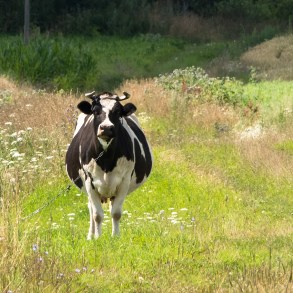
Bessie keeps watch. What’s Lithuanian for “moo”?
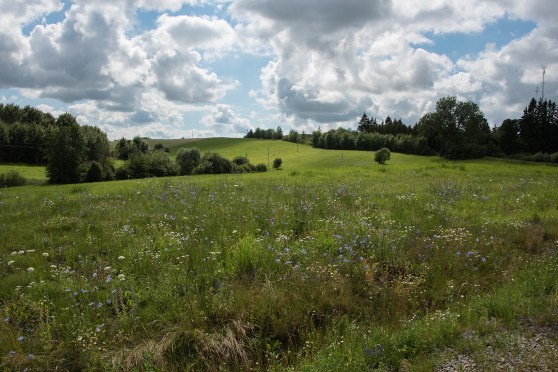
The website says that the Mardosa house was later used as a school for the village children in the 1950s and early 1960s before a larger school was built nearby. But in an extra twist, Birutė doesn’t think that this Mardosa house was filled with our Mardosas. According to her, there were two Mardosa families (Siberia for both, apparently), and our peeps were in the other house. Both houses are gone now, but she and Vytautas showed us the fields where our Mardosas lived. A cow keeps watch now.
I’m still astounded at how this visit all worked out. Apart from the clutch, it couldn’t have gone better.
I stupidly did not take near enough pictures in Verebiejai that day. More pics are below, including some shots from our drive through Giluičiai, where my great-grandmother Mary Kupčinskaitė was from. It’s even smaller than Verebiejai, just a few houses along the deep lake that gives the town its name. I saw kids going fishing and swimming on a nice summer day. A country boy himself, I think my Dad would have loved living there. The other town we buzzed through was Balbieriškis, where Mary Mardosaitė’s husband Joseph was from.


It’s amazing how this all worked out. I wish we could have stayed longer. I could tell Birutė would have hosted us all week if we’d asked.
Many thanks to Irma Žvinakienė from the Alytus history museum for writing that website and giving us the grand tour.


 Exploring our Lithuanian Roots